HF and propagation
What’s open, which way to point, and where to tune.
Day, night and greyline
day greyline night sun beacon transmitting Greek signals heard (PSKReporter, colour by band) Range rings at 2,500, 5,000, 10,000 and 15,000 km
Your station
kept in this browserLoading…
| kHz | Beacon | Beam | km | There |
|---|
Contest
now and this weekLoading…
Source WA7BNM Contest Calendar
The bands now
| Band | Forecast | Spots | From SV | Heard from Greece | Hearing Greece | FT8 | FT4 | WSPR |
|---|---|---|---|---|---|---|---|---|
| 160m | – | – | – | – | – | 1.840 | – | 1.8366 |
| 80m | – | – | – | – | – | 3.573 | 3.575 | 3.5686 |
| 60m | – | – | – | – | – | 5.357 | – | – |
| 40m | – | – | – | – | – | 7.074 | 7.0475 | 7.0386 |
| 30m | – | – | – | – | – | 10.136 | 10.140 | 10.1387 |
| 20m | – | – | – | – | – | 14.074 | 14.080 | 14.0956 |
| 17m | – | – | – | – | – | 18.100 | 18.104 | 18.1046 |
| 15m | – | – | – | – | – | 21.074 | 21.140 | 21.0946 |
| 12m | – | – | – | – | – | 24.915 | 24.919 | 24.9246 |
| 10m | – | – | – | – | – | 28.074 | 28.180 | 28.1246 |
WSJT-X dial frequencies in MHz, USB. Green dot: a Greek signal heard beyond 2,500 km in the last 15 minutes.
Greek DXCC entities on the air
cluster spots, last hour- Greece SV SW SX SY SZ J4–
- Crete SV9 J49–
- Dodecanese SV5 J45–
- Mount Athos SV/A–
Each counts as a separate DXCC entity.
Where Greece is getting out now
PSKReporter, 15 minutesLoading…
Stronger colour, better path.
Propagation
Sun, Kp, the Athens ionosonde and a MUF map.
Sun and geomagnetic field
Loading…
HF forecast
| Bands | Day | Night |
|---|---|---|
| Loading… | ||
Based on the solar indices.
Kp, last 7 days
Loading…
quiet, Kp below 4 active, 4 storm, 5 and above (G1–G5)
Athens ionosonde
Loading…
MUF(3000): the highest frequency for a 3000 km hop foF2: vertical incidence, NVIS
What the ionosonde says is open
| Band | 3000 km | Short range (NVIS) |
|---|---|---|
| Loading… | ||
Open below the MUF. Short-range contacts need a band below foF2.
MUF map
KC2G, from ionosondes worldwide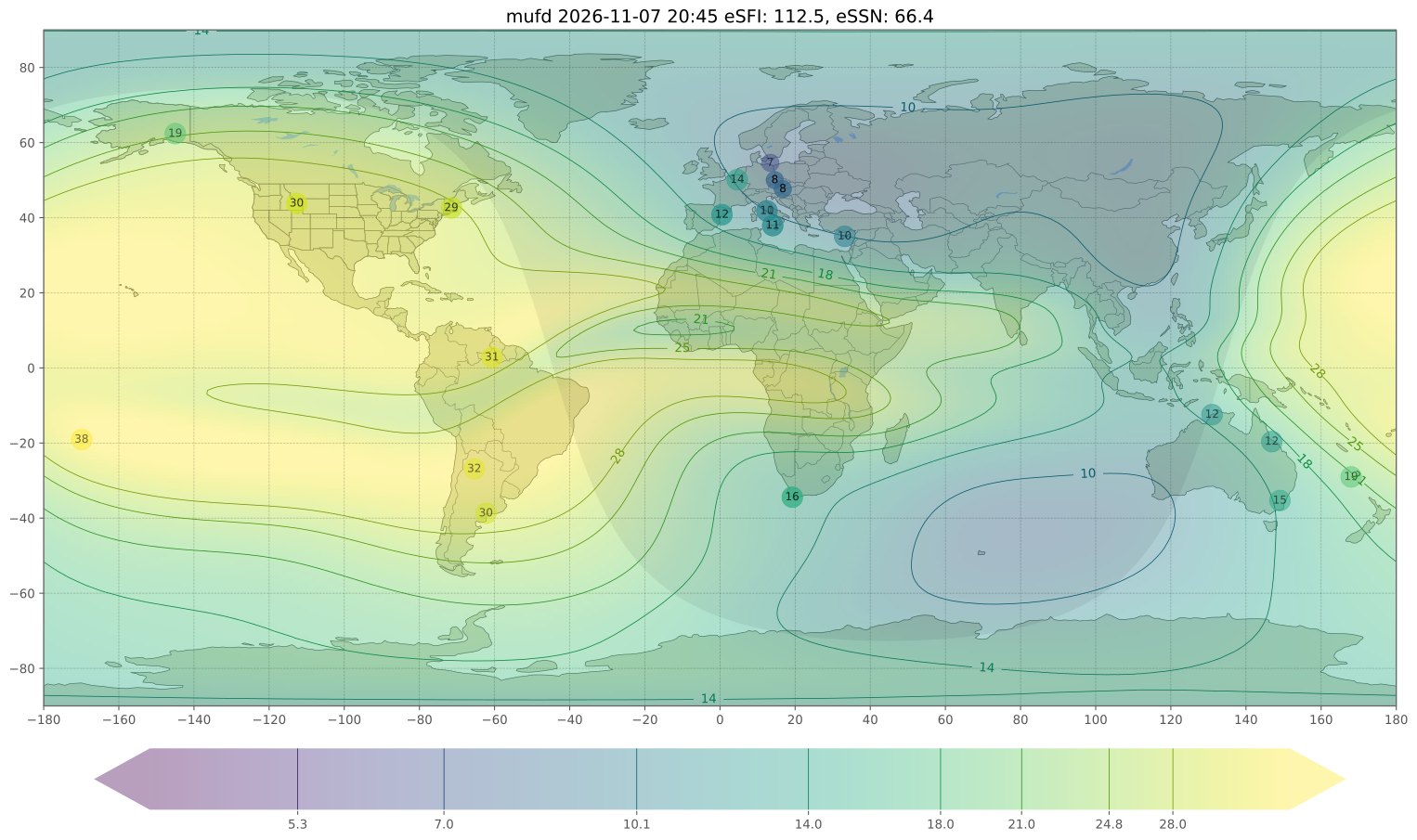
Map: prop.kc2g.com (KC2G), GIRO data. MUF for a 3000 km hop, in MHz.
Nearby ionosondes
MHz| Station | km | MUF | foF2 | UTC |
|---|---|---|---|---|
| Loading… | ||||
From KC2G (GIRO). Old readings are greyed out.
What the exam bank says
- More sunspots, more ionisation, higher MUF: the upper HF and lower VHF bands open for DX. Q 129
- Operate below the MUF, as close to it as you can. With a MUF of 15 MHz, use 20 m. Q 80
- Intercontinental QSOs go mainly via the F2 layer, up to about 4000 km per hop. Q 93
- Sporadic E appears mostly in summer, with hops of up to about 2000 km. Q 115
- At twilight (the grey line) absorption drops while the upper layers stay ionised. Q 122
- A solar flare affects propagation within 10 to 30 minutes. Q 77
For the HF shack
- DX clusterLive spots from SV2RIM-3, with a band filter
- FT8 receiverDecode FT8 and FT4 from your rig, in the browser
- Who hears GreecePSKReporter: where Greek signals are heard
- NCDXF beaconsWhich beacon is transmitting, and where from
- Band planIARU R1, CW, SSB, FT8, WSPR, entry level
- WebSDR and KiwiSDRHear yourself on remote receivers
- VOACAP predictionPoint to point, by hour and band
- ContestOn this week
- AntennasDipole, vertical, SWR, feed line, dB
- LogbookLogging, ADIF, QRZ
- AwardsDXCC, WAS and more from your ADIF
- Propagation theoryFrom the exam bank, with explanations (Greek)
Telnet to the cluster: dx.sv2r.im 7300 (DXSpider with RBN). Log in with your callsign.